|
Overview
When we try to learn about the world around us by moving out of our comfort zones, what do we really learn?
Do we learn objective truths about the "other" people? Do we learn about ourselves as our enthusiasms, fears, prejudices, and naïvely gullible wishes come to the surface?
These readings suggest that one of the best ways to explore yourself, your belief structure, and your ways of knowing the world is to defamiliarize yourself.
Perhaps it means travel. It may require one to question values, beliefs and previously held notions about beauty. You may have to re-examine your ideas about how people relate to each other.
Sometimes one can take one's exploration / adventure too far. It can endanger the health and welfare of others. At other times, one can find that one is not going far enough. When do you know? What is appropriate? Consider the text. Analyze for deeper significance. Have you ever found yourself doing the same things?
Readings
THEORETICAL BASES
Lesser, Wendy. "Hitchcock's Couples" in His Other Half: Men Looking at Women Through Art. Cambridge, MA: Harvard UP, 1991.
Lesser, Wendy. "The Disembodied Body of Marilyn Monroe" in His Other Half: Men Looking at Women Through Art. Cambridge, MA: Harvard UP, 1991.
Richard, Nelly. "Postmodernism and Periphery" in Postmodernism: A Reader. ed. Thomas Docherty. NY: Columbia UP, 1993.
Roland Barthes, Elements of Semiology (1964)
Roman Jakobson, Six Lectures on Sound and Meaning (1942)
"indo-chic" by ananya mukherjea
Several months ago, a boy I know--a smart and gracious boy, but one I know pretty damn peripherally--asked me casually what I think of all this new "exotic style."…
From Indo-chic to Ethno-kitsch: an angsty review of a record review
Since I wrote about Indo-chic for the first episode of Make, I've had several conversations with various people about what it is that really bothers me about exoticism. (…)my response is not just about pop-cultural appropriations, it's the residue of centuries of inter-cultural confrontation. …
Hindu Women's Customs
Music
"In Praise of Bjork" by Amy Bell
MTV -- India
Why MTV digs India? By Vamsee Juluri
Film & Television
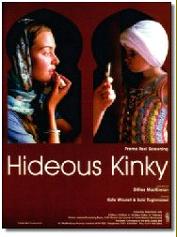
Hideous Kinky -- review by Roger Ebert
Hideous Kinky -- review by Ian Waldron
Literature -- Short Stories // Prose
Luisa Moreno de Gabaglio "The Hannemann House"
Ginsberg, Debra. "Tipping: It's Not a City in China" in Waiting: The True Confessions of a Waitress. NY: Perennial, 2001.
POETRY
Baudelaire, Charles
Les Fleurs du Mal
Anna Akhmatova
"In Memory of M.B."
Patricia Young
"Ruin and Beauty" (2000)
|
|