|
Reading from Required Texts
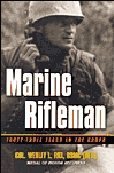
Fox, Wesley L. Marine Rifleman.
Daft, The Leadership Experience
Daft, R. L. The leadership experience. Mason, OH: Cengage South-Western.
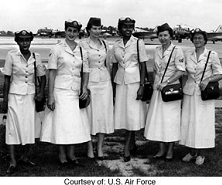
Military Readiness: Women Are Not a Problem. Rand Reports.
Reading from Online Readings
Procedure for reading -- read quickly, for concepts rather than detail. Choose two or three to read more closely. Please think of ways that what is occurring in the text relates to a current contemporary situation, or a leadership / management issue that you have encountered or been aware of. Be sure to relate the reading to current historical & political issues as well!
In Marine Rifleman: Forty-three Years in the Corps, Col. Wesley L. Fox, USMC (Ret.), former deputy commandant of cadets at Virginia Tech, tells his "life story as a Marine the way [he] remembers it." Retired from the Marine Corps in 1993, Fox is the quintessential soldier's soldier, having received the Medal of Honor, two awards of the Legion of Merit, a Bronze Star with Combat V, four Purple Hearts, and numerous commendations. Fox's memoir begins with his youth in rural Virginia as a ninth-grade dropout and teenage farmer who fulfilled his dream of serving his country by enlisting in the Marines in the early years of the Korean conflict. Subsequent chapters narrate Fox's steady rise through the ranks, and each concludes with a list of "lessons learned."
Dr. Nash's note: What I liked about this book is that it provides an evolutionary view of leadership, that begins with followership. It was interesting to me to read about Col. Fox's experiences as a 19-year-old in the Korean War (what a horrific experience, which personalizes the faceless statistics), and then in Vietnam, where guerrilla tactics and unethical fighting by the enemy were the norm. It was intriguing to see how his leadership vision evolved -- I could see that it was built on practical experience and empathy. He does not base his leadership philosophy on a particular ideology or philosophical leaning. As a result, I found the later chapters to be a bit dull (I have no way of relating to them); but the day-to-day dehumanization and rehumanization of war was very touching. It made me realize that discipline and keeping a focus on the values that keep you human go a long way, even if they do seem untenable in certain situations (like combat).
I like to think of Marine Rifleman in terms of Richard Dawkins' idea of memes. Memes are ideas or concepts that seem to replicate instantly through societal consciousness, and they create their own reality. Powerful memes are in collision course in our life and times -- for example, the meme of victimization because of post-colonial globalization is one that is in direct conflict with the meme of global prosperity through technology. There are also meme-sources -- the powerful characters, ideas, or concepts that find themselves in mirror images throughout our world -- often propagated via the media. I see Col. Fox as a kind of meme-source of the quiet hero.
I also very much admire the values- and discipline-based approach which characterizes the military. Without it, there appear to be no limits to the depravity of the human being. A leader puts things into perspective and sets the tone for the entire organization. If they have a "by any means necessary" attitude, what are the implications? If the leader projects elitism, bullying, or cruel acts, what are the implications?
|
|